Hamburg, Between the Harbour and the Glass
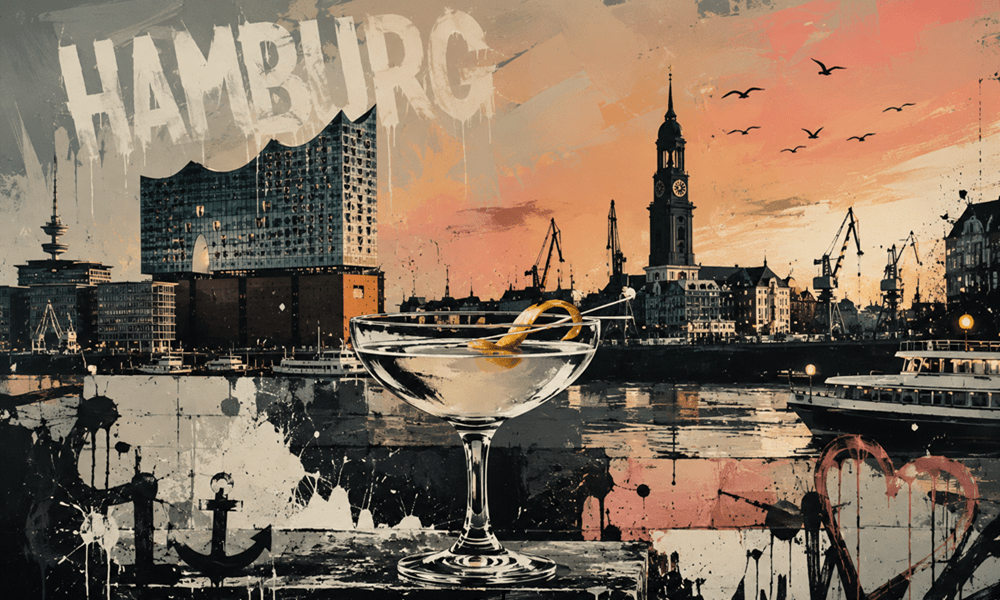
For centuries, Hamburg has been a city shaped by trade, travel, and the sea. Germany’s largest port has always been a gateway between Northern Europe and the wider world, welcoming sailors, merchants and immigrants who carried not only goods but drinking traditions with them. Long before anyone spoke about craft cocktails, Hamburg was already a city that understood the social ritual of gathering over a glass.
That rhythm has a longer memory than most visitors realise. You can still sense it in the older taverns scattered around the harbour, where generations of dockworkers and sailors once warmed themselves with Kümmel or schnapps before heading back into the cold. But the Hamburg we know today as one of Europe’s great cocktail cities is a much younger story.
The foundations of the modern scene were laid during the late 1990s, when pioneers such as Uwe Christiansen began introducing the precision, hospitality and respect for classic American cocktails that would redefine drinking in the city. At a time when cocktails elsewhere in Germany often meant bright colours and sweet mixers, Hamburg quietly began looking backwards to move forwards, rediscovering forgotten classics, fresh ingredients and meticulous technique. Then came another defining chapter. In 2007, Jörg Meyer opened Le Lion Bar de Paris. The bar would become one of Europe’s most influential cocktail destinations and the birthplace of the Gin Basil Smash, a drink that quickly travelled around the globe and introduced countless bartenders to Hamburg. Le Lion didn’t create the city’s cocktail culture—it gave an already flourishing movement an international stage.
What I love most about Hamburg, though, is that it never stopped there. Instead of becoming a city defined by one legendary bar, it continued evolving through its people. One generation inspired the next, and today’s scene stretches far beyond the classics. From neighbourhood favourites to ambitious newcomers like The Chug Club, The Local, Collab, Ba Nomu, Nick & Nora and Liquid Garden, every bar seems to contribute its own voice while remaining unmistakably Hamburg.
Perhaps that’s what impressed me most. For all its international acclaim, Hamburg has retained a distinctly Hanseatic sense of modesty. The city’s best bars rarely chase spectacle. Instead, they focus on craftsmanship, quiet confidence and genuine hospitality. It’s a scene where technique serves the guest rather than the bartender’s ego, where innovation feels purposeful instead of performative. That hospitality stayed with me long after the drinks themselves.
After spending a little time in Hamburg, I started noticing the city in smaller details: the cool air rolling in from the Elbe, the sound of gulls reminding you how close you are to the water, the easy rhythm that makes Hamburg feel less like somewhere to visit and more like somewhere to settle into. As evening falls, another side of the city emerges. Doors open, lights soften, glasses begin to fill, and every bar tells its own story.
These are the places I followed—and the stories that left me stirred, not shaken. Join me on a sip or two.
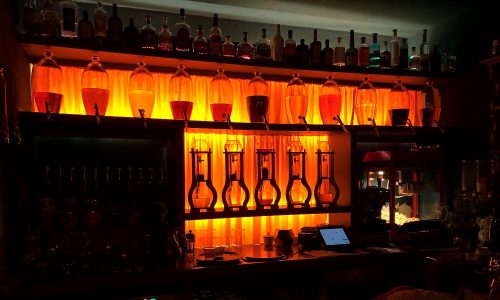
Bā Nomu — Where Memories Become Cocktails
Some bars you stumble upon. Others sit quietly on your list for far too long, waiting for the right evening. Bā Nomu was one of those for me. I had been meaning to go for ages. Every now and then, the name would come up in conversation with bartender friends, usually followed by the same prediction: You’ll love it. They know my taste rather well by now, so perhaps I should have listened sooner. Eventually, I pushed open the door. They were right.

Read the full story →
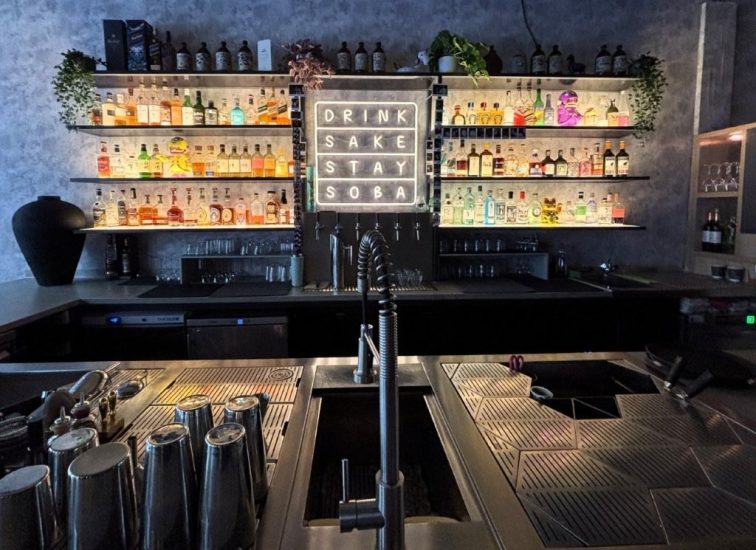
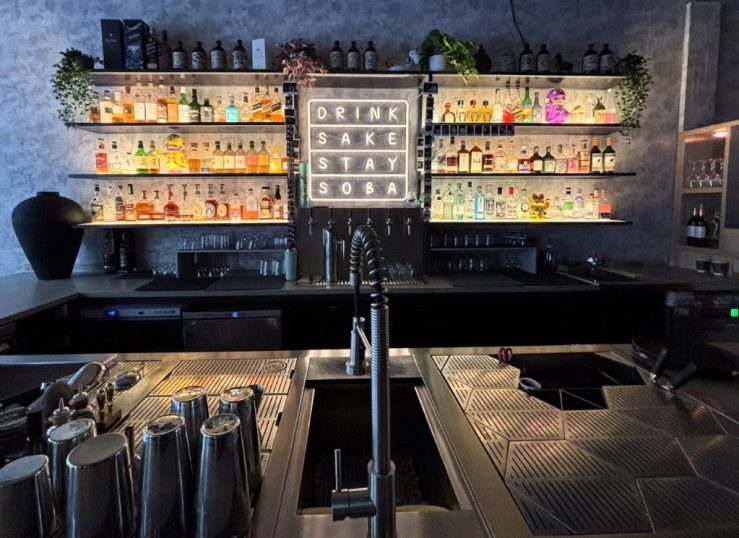
The first thing that caught my attention wasn’t a bottle or a drink, but the bar itself. The counter sits unusually low, paired with custom-made stools that bring you closer to the people working behind it. It’s a small design detail, but one that changes the entire feeling of the room. That familiar barrier between bartender and guest almost disappears. You’re not looking up at someone working on the other side of a counter; you’re sitting with them. And that is exactly where I wanted to be. I settled in, started talking to the team and did what I tend to do when I feel comfortable at a bar: stayed longer than planned and tasted considerably more of the menu than intended.
Bā Nomu opened in 2022, bringing the kitchen and the bar unusually close together. Street food, home cooking and flavours from across Asia find their way into the glass, interpreted through contemporary cocktail techniques. Clarification, fermentation, distillation and fat-washing all play their part, but thankfully none of them feels like the point. They happen somewhere behind the scenes. What reaches you across the counter is simply flavour.
At Hamburg’s Bā Nomu, flavours travel between cultures, the kitchen finds its way into the glass, and the best conversations happen close to the bar.
Dustin is at the heart of it, and there is an ease to the way he and the team work that only comes with experience. Nothing needs to be loudly explained or demonstrated. You taste the thought behind the drinks, while the rest happens through conversation, curiosity and that wonderfully unhurried kind of hospitality that makes another round seem like an entirely reasonable idea.
East meets West is the thread running through the menu, but Bā Nomu doesn’t turn it into a slogan in the glass. The two aren’t placed against each other for effect. They simply meet, borrow from one another and occasionally take you somewhere you weren’t expecting to go.
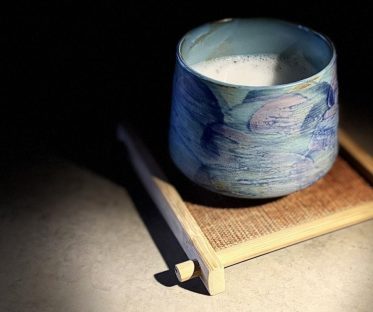
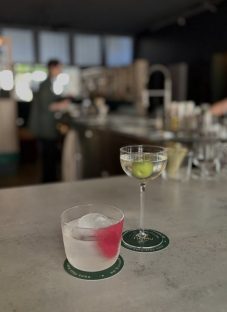
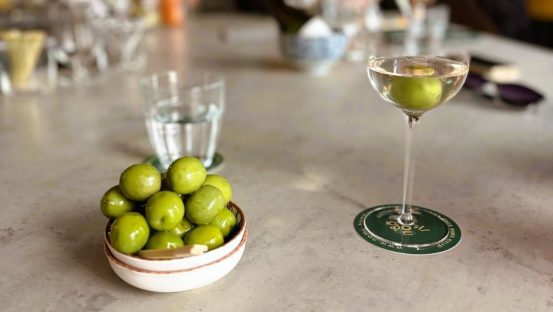
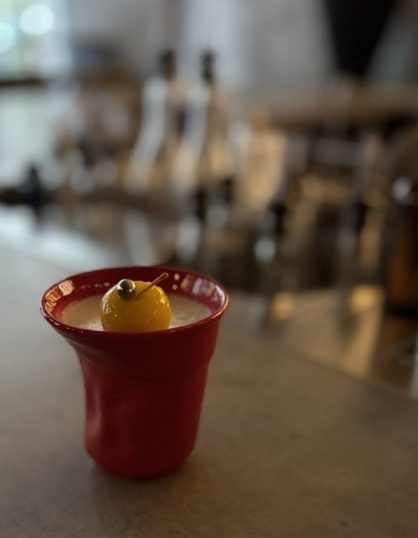
Overdrive did exactly that. Tequila Blanco meets Junmai sake and chilli oil, moving between brightness, savoury depth and a gentle heat that seems to arrive a fraction later than everything else. One sip makes you curious. The next makes considerably more sense. And then the glass is empty. But there was one I kept returning to – the Sake House Sour. I have a weakness for drinks that appeal to the nose before they reach the lips, and this one had me immediately. Nigori sake and yuzu sake meet almond orgeat, lime and green Szechuan pepper beneath a wonderfully soft foam. There was something almost perfume-like about its aroma — delicate, floral, perhaps even reminiscent of an expensive body lotion, in the best possible way. Then you take a sip and discover how refreshing it actually is.
But when I think about Bā Nomu now, it isn’t chilli oil, sake or Szechuan pepper that comes back first. The conversations across it. Watching the team work while talking about drinks, ingredients and whatever else the evening happened to bring. The best bars aren’t simply places where somebody makes you a good drink. They’re places where you settle in, become curious, start talking — and suddenly notice that considerably more time has passed than you intended. Bā Nomu was one of those nights. I should have listened to my bartender friends sooner!
Collab Bar — Equal Drinking, Familiar Faces
Collab Bar opened in summer 2023 and was another place that had been sitting on my list for far too long. My time in Hamburg finally gave me the opportunity to visit some of those bars that had been on my mind for ages — especially as one of the brains behind Collab is none other than the lovely Chloé Merz. We first ran into each other in Vienna back in 2018 and crossed paths several times afterwards. Now, Chloé has made Hamburg her home.

Read the full story →
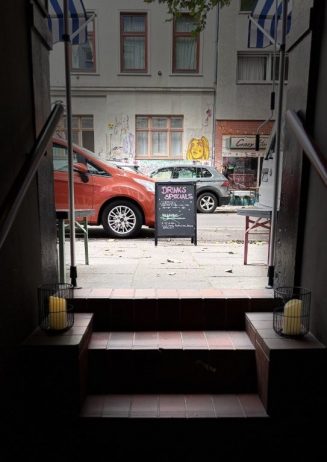
After Bā Nomu, my next stop took me a few streets further into St. Pauli, down Hein-Hoyer-Straße and, quite literally, a few steps below street level. Collab sits in a Souterrain, giving you that slightly secretive feeling I have always liked about basement bars without completely shutting the outside world away. You descend into the room, yet daylight still finds its way through the windows. Somewhere between cellar and street level, the bar has created its own little perspective on St. Pauli. And then there is the counter. Apparently Hamburg had decided that unusual bar counters were going to become a theme of my trip.
After sitting unusually low at Bā Nomu, Collab presented me with another geometry altogether. The counter bends and extends into the room, creating little corners of its own. I found my favourite immediately: a seat at the side, almost like an extra piece of the bar, with the window behind me and the whole room opening up in front. For a Barstalker, rather perfect.
I could watch the team work, see people arriving and settling in, follow what was happening across the room — while still feeling tucked into my own little corner. And then came the nicest surprise. I was greeted by Lucrezia. I knew her from Düsseldorf, where she had been one of my favourite bartenders at Square Bar. She moved to Hamburg some time ago, and finding her here suddenly made Collab feel considerably less like a first visit.
There is something wonderfully reassuring about meeting people from your own bar history in another city, behind another counter. The surroundings change, the menu changes, perhaps even the drinks change — but the connection is immediately there again. Rather appropriate in a bar called Collab.
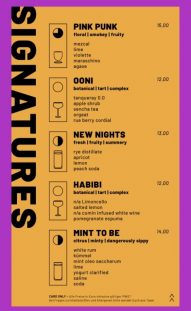
The philosophy behind the bar is something Chloé and the team call Equal Drinking. The idea sounds almost too simple: drink what you want. But look at most cocktail menus and you realise how unusual that still is. Non-alcoholic cocktails are often sent to their own little corner, while low-ABV drinks occupy another niche. At Collab, that hierarchy disappears. Whether a drink contains no alcohol, a little, or considerably more, the ambition behind it remains the same. The menu clearly shows the alcohol strength, leaving you to choose according to your mood rather than what a cocktail is supposedly meant to be. I like that. Not because I suddenly plan to abandon high-proof content, obviously.
But because good drinking has never been about the highest number on a bottle. It is about flavour, balance, mood — and sometimes simply knowing what you feel like having next.
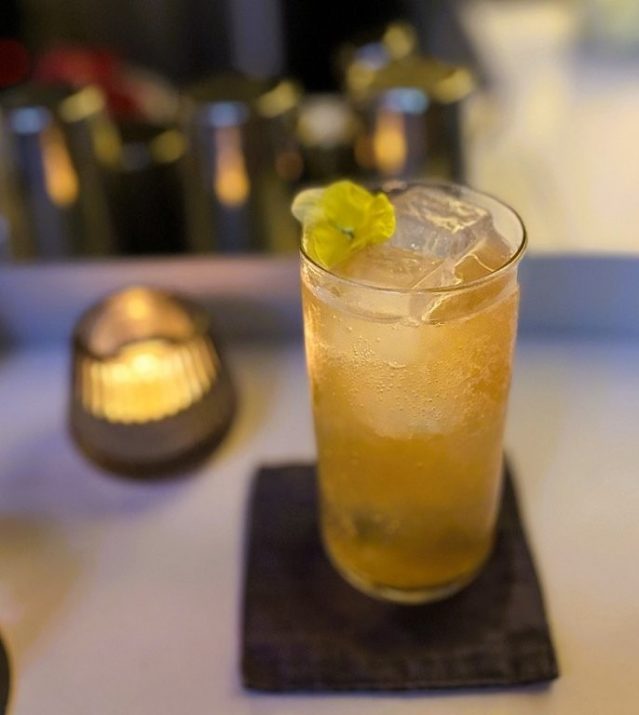
My first choice wasn’t particularly difficult. Being an agave lover, a combination of mezcal, violet, maraschino, lime and agave was always going to catch my attention. The drinks at Collab are contemporary without becoming unnecessarily complicated. Sweet, savoury, fruity and vegetal flavours move comfortably alongside each other, with unexpected ingredients appearing when they actually have something to contribute.




And perhaps that’s the clever thing about Collab: despite the philosophy behind it, the bar never feels like it’s trying to teach you something. You sit down. Choose a drink. Talk. Have another one. Music plays, people come and go, and the idea of Equal Drinking simply exists quietly in the background.
That approach has travelled well beyond St. Pauli. At the Mixology Bar Awards 2025, Collab was named New Bar of the Year — remarkable recognition for a bar that still manages to feel like a neighbourhood place. But that’s not what I remember first. I remember walking those few steps down from the street. Daylight slipping into a room that should somehow have felt like a cellar. My peculiar little seat at the side of the counter from where I could watch everything.
Maybe that’s why the idea of Equal Drinking makes sense to me beyond alcohol percentages. Bars have always been equalising places at their best. Different people arrive, sit beside one another, order different things and share the same counter for a while. Sometimes you meet someone new. Sometimes you find someone again.
The Local – Come for a Drink, Stay for Another
The best bars are rarely defined only by what they serve. They are defined by the moments they create. And at The Local, I stayed much longer than expected — so the title for this chapter was rather obvious. The bar had been sitting on my list for a while. The final nudge came, somewhat indirectly, from Bratislava: when I visited Mirror Bar last September, I learned that the team had previously done a guest shift at The Local. Another little connection between bars and cities, and another reason to finally find my way there.
Read the full story →
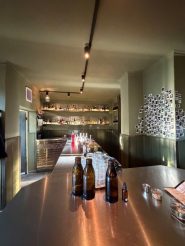
Apparently Hamburg wasn’t finished with interesting bar counters yet. After the low intimacy of Bā Nomu and my little observation post at Collab, The Local gave me another one to remember — and possibly my favourite piece of bar furniture of the trip. At first, it’s the shape that catches your eye. The counter doesn’t simply run obediently from one end of the room to the other. It turns, opens up and creates little corners of its own. On top, stainless steel reflects glasses, bottles and the constant movement behind the bar; underneath, dark-green tiles soften the look and give it a sense of history.
And there is history. When Oliver Singh transformed the former neighbourhood pub into The Local, he kept the existing green tiles — some dating back to the 1970s — and placed a custom-made octagonal stainless-steel counter above them. Old Hamburg underneath, something sharper and more contemporary on top. So I took my place.
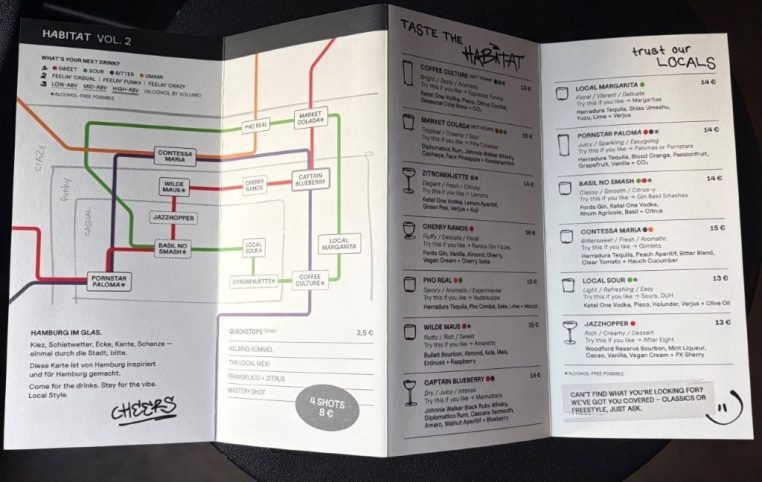
The Local opened in December 2021, but the local in its name is more than branding. Inspired partly by British pub culture and Oliver’s time in London, the idea is refreshingly uncomplicated: a place around the corner where you don’t need a special occasion to walk through the door. A serious cocktail, a highball, a beer — nobody needs to justify what they order. The menu keeps things beautifully uncomplicated. It isn’t enormous, and that’s a good thing. The drinks are clearly structured, the design is easy to understand, and each cocktail comes with a little piece of Hamburg attached to it.
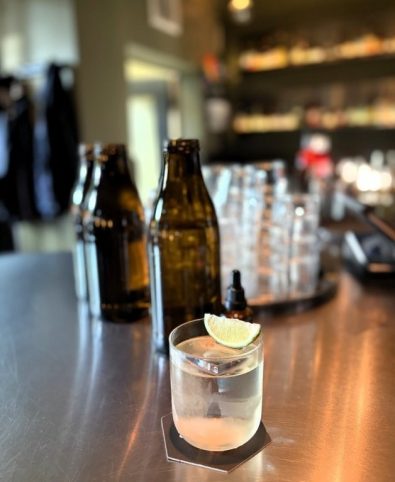
The cocktails themselves have something in common: clarity. Not necessarily visually — although there is plenty of that too — but in flavour. Ingredient lists are kept tight enough that you can actually taste what is in the glass. Nothing seems to have been added simply because it could be. And then there are the details. The glassware is beautifully simple. Nothing screaming for attention or arriving dressed for Instagram before you’ve even tasted it. And the ice — clear cubes that make someone stop talking for a moment just to inspect the glass.



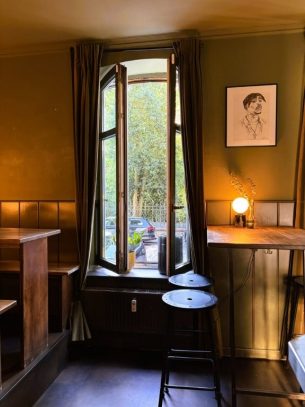

I started with PHO REAL, mainly because it was impossible for me to read savoury, aromatic, experimental and move on. Tequila, pho cordial, sake, lime and mezcal come together in a drink inspired by Vietnamese food culture in Hamburg. The menu rather charmingly tells you to try it if you like Nudelsuppe (Noddle Soup). It was savoury and aromatic without becoming heavy, with the agave spirits providing enough structure to carry all those pho associations while still remaining very much a drink rather than dinner in a glass.
Next came CONTESSA MARIA. This time the reference point was a Gimlet: Tequila with peach aperitif, a bitter blend, clear tomato and a touch of cucumber. Bittersweet, fresh and aromatic, with tomato bringing savoury depth without taking over the glass. Then I moved into creamier territory with the MARKET COLADA. Rum, Whisky and Cachaça meet condensed milk and something the menu simply calls faux pineapple. But there is no pineapple hiding behind that name. Instead, rhubarb and carrot recreate those familiar sweet-tart, tropical associations. And I loved that little trick. A Piña Colada usually takes you somewhere considerably more tropical than Hamburg. Here, the team brings it back home, replacing pineapple with ingredients that make sense much closer to their own doorstep. It fits beautifully into the hyper-local direction of the menu: take something familiar, keep the memory of its flavour, but rebuild it through a Hamburg lens. Being a coffee lover, COFFEE CULTURE was always going to happen. Vodka and Pisco meet citrus cordial, seasonal cold brew and CO₂ in a bright, zesty take on the world of Espresso Tonics. Coffee in cocktails can easily become dark, sweet and heavy; this went in exactly the opposite direction.
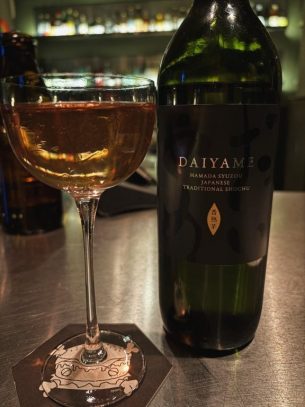
And then came the drink that wasn’t on the menu at all. One Last Bamboo. Anyone who has followed my travels for a while — and certainly a few bartenders who have had me sitting at their counters — knows about my weakness for a Bamboo. It’s my go-to low-ABV drink. I love that meeting of nutty sherry and aromatic vermouth: quiet, elegant and proof that a cocktail doesn’t need much alcohol or a long ingredient list to have character. So, naturally, I asked for one. I took the first sip. Delicious. But there was something else. Something strangely familiar. A little Japanese subtitle running underneath the Bamboo I knew. Then I discovered what the bartender had used: Daiyame Shochu. And suddenly I was back in Japan. I first came across Daiyame at Yakoboku in Kumamoto, another bar counter and another chapter of my travels. It’s an imo shochu made from sweet potato, but forget any expectation of something earthy and heavy. Daiyame is astonishingly aromatic, with notes that can remind you of lychee and delicate florals. Those fragrant, almost perfumed qualities made perfect sense alongside the sherry and vermouth. Hamburg had somehow poured me a little memory of Kumamoto. Those are the drinks I love most. Not necessarily the most complicated ones, or those involving the newest technique, but the ones that unexpectedly connect places, people and memories. One sip and suddenly two bars thousands of kilometres apart are sitting in the same glass. And perhaps that is where my evening became slightly less disciplined than intended.
The dangerous thing about The Local isn’t that somebody talks you into another drink. Nobody needs to. It’s that peculiar combination of a comfortable stool, very good cocktails and people behind the counter who make staying feel considerably easier than leaving. One drink becomes another. A conversation continues. Somebody pours something interesting. You look at the time considerably later than you intended to.
There is a warmth to the team that makes the name The Local begin to make sense surprisingly quickly. Hospitality isn’t something added on top of the drinks as another element of the concept. It is the concept. And I hope it stays exactly that way.
Liquid Garden — Around the World Without Leaving the Bar
On a rainy Hamburg evening, an empty bar stool, a world map and a friendly team gave me plenty of time to explore. Hamburg had shown me quite a few sides of itself by then. This particular evening it chose perhaps its most predictable one. Rain. Not dramatic rain. Just that persistent grey Hamburg drizzle that makes walking around the city considerably less attractive and finding a warm bar considerably more so.
Read the full story →
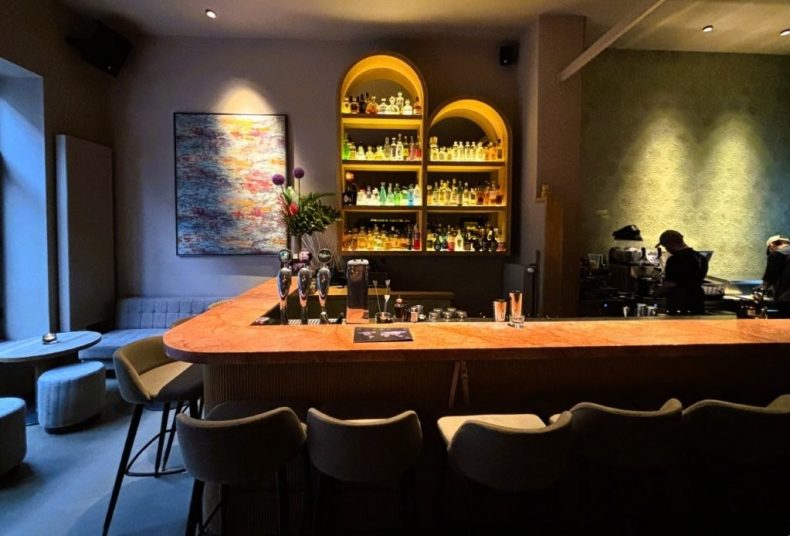
When I arrived at Liquid Garden, I was the first guest of the evening. There is something special about arriving before everyone else. For a short while, you get to see a place before the evening begins. The bottles are lined up, the room is still, the bartenders haven’t disappeared into a stream of orders yet. And, most importantly for me, they have time to talk. So I took my seat at the bar.
Liquid Garden opened in July 2021 in Hamburg’s Kontorhausviertel. The location feels particularly fitting for a bar built around travelling through flavour. This part of Hamburg grew from the city’s history of trade and commerce, with goods, spices and ideas arriving from far beyond the harbour. Today, the Kontorhausviertel and neighbouring Speicherstadt form part of Hamburg’s UNESCO World Heritage ensemble. And here I was, escaping the rain and being handed a map of the world. Rather appropriate. The idea behind Liquid Garden can be summed up in one sentence: “We mix the gardens of the world.” And for once, the concept actually does what it says.
Instead of simply organising cocktails according to spirit or style, the menu takes you travelling. Nordic, Mediterranean, Asian, Caribbean, African, Oriental and Latin American Gardens each build their drinks around flavours associated with those regions. You don’t really choose between a Sour and a Highball. You choose where to go next. Herbs, teas, fruits and spices create the flavour language of each stop. Behind them are infusions, fermentation, clarification, foams and all the other toys of contemporary bartending — but sitting at the counter, none of it felt like a laboratory demonstration. Perhaps that’s because I had arrived early.
Whenever I became curious about something, somebody behind the counter had time to explain it. An ingredient led to a technique, a technique to a story, and inevitably the story made me curious about another drink. Dangerous circumstances for a Barstalker.
I started my little world tour in Latin America with La Vida Verde. Tequila and Paranubes Rum meet lime, pineapple, jalapeño, coriander, mint and tomatillo. There is a lot going on on paper, yet the drink doesn’t taste crowded. It’s fresh and vegetal, fruity and sour, with just enough sweetness before that green, spicy edge arrives. Somewhere underneath it all is the familiar soul of a summer Margarita — just one that has wandered through a particularly well-stocked garden first. Bright, refreshing and a very good way to start travelling.

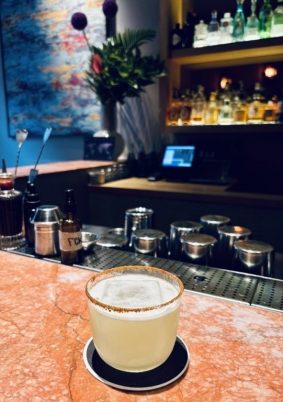


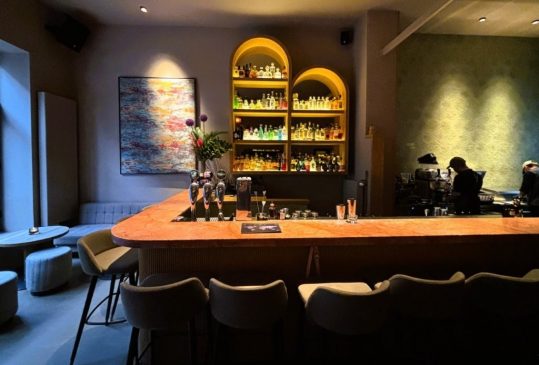
From Latin America, I moved on to the Oriental Garden with the Cascara Rosso. And the mood changed completely. Mancino Rosso, Berto Rosso and Campari meet amarena cherry, cascara tea and sumac in a light, gently sparkling low-ABV drink. Bitter and fruity play against one another, while the cascara and sumac give it an aromatic edge that makes you return to the glass to work out exactly what you’re tasting. And then there were the chocolate-covered cherries served alongside it. A little sip. A little bite. Another sip. Dangerously easy.
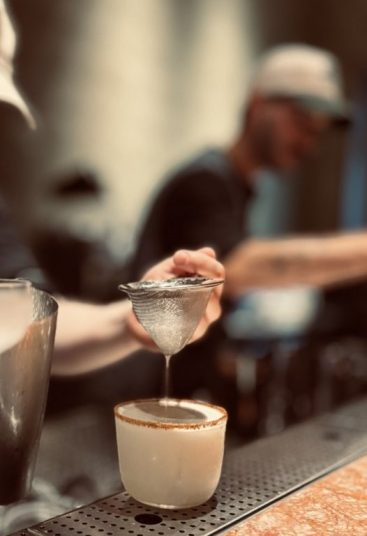
My final stop wasn’t actually one of the seven Gardens. It belonged to Jesse, one of the bartenders behind the counter. One Last Margarita. Salina was created by Jesse for the Cointreau Margarita Challenge, where it took him all the way to the German final. And since there was a Margarita involved, I obviously wasn’t going to leave without trying it. At its heart, Salina starts with something completely familiar: lime, salt and the basic idea of a Margarita. Then Jesse takes it apart. Pumpkin-seed-infused tequila, fresh fennel shrub, Cointreau and a touch of mezcal recreate the flavours of a fennel and orange salad — an unusual reference for a cocktail, but one that suddenly makes complete sense when you taste it. Bright. Herbal. Citrusy. And then there is the lime and salt espuma sitting on top. Instead of leaving salt around the rim and lime somewhere inside the drink, two of the Margarita’s most recognisable elements become part of its texture and aroma. You meet them before the liquid itself. It still tastes unmistakably like it belongs to the Margarita family, but everything has shifted slightly. The familiar is still there; you just approach it from another direction.
And perhaps that sums up Liquid Garden rather well. Seven Gardens, Seven Stories. What I also liked was the restraint of the menu. There isn’t an endless catalogue of signatures competing for attention. There are seven Gardens and seven signature drinks, accompanied by a couple of creations from the Bartender’s Backyard.
That’s enough. In fact, it feels confident. Each drink has a reason to be there, each Garden gets its own little story, and by the time you’ve understood the map you’ve probably already started thinking about where you want to travel next. The room itself follows a similar philosophy. Liquid Garden is brighter than many serious cocktail bars. There is no attempt to hide everything behind darkness, velvet and candlelight. Green tiles, carefully chosen lighting and botanical details give the space a contemporary feeling somewhere between cocktail bar and design space.
Being the first guest certainly helped. There was time for questions and answers that weren’t rushed. The team spoke about ingredients, techniques and ideas with enthusiasm, but without ever turning the evening into a lecture. And gradually, while the Hamburg rain continued somewhere outside, other guests began arriving. Conversations started. Glasses appeared across the bar. The quiet room I had walked into slowly became a lively one. I had started the evening escaping Hamburg’s rain. Instead, somebody handed me a world map. And naturally, I started travelling.
Karo Karo — A Bar for Both Halves of the Day
Coffee, cocktails and good company in the Karoviertel — because not every Barstalker story has to begin after dark. Most of my bar adventures start with an empty stool at a counter. This one started with my neighbour — or rather, with one of those funny coincidences that make the world feel surprisingly small. We both come from a small village in the Palatinate in southern Germany, several hundred kilometres from Hamburg, yet somehow we found ourselves in the city at exactly the same time. So, of course, we decided to meet. And eventually, I took her to a bar.

Read the full story →
By coincidence, we were both spending time in Hamburg, so instead of another solo Barstalker mission, we decided to explore a little of the city together. And eventually, of course, I took her to a bar. Some habits are difficult to suppress.
Our destination was Karo Karo on Marktstraße in the Karoviertel, that lively pocket between St. Pauli and the Schanze. Opened in June 2025, it follows a wonderfully uncomplicated promise: Coffee. Aperitivo. Wine. Beer. Snacks. Or, as they put it themselves: Think Tagesbar but make it love the night. I liked that before I’d even ordered anything. There shouldn’t really be a moment when a café suddenly has to become a bar. At Karo Karo, the afternoon simply moves along. An espresso becomes a glass of wine, someone orders an aperitivo, perhaps a Martini appears. Nobody needs to announce that daytime has officially become evening. The room has the same lightness. A massive tiled counter anchors the otherwise minimalist space, while colourful George Sowden lamps add little playful accents. It feels stylish, but more importantly, easy — the kind of place where you stop for coffee and somehow find yourself staying for aperitivo.
Going to bars with someone else is always interesting. When travelling alone, I tend to disappear into the counter, talk to bartenders and inevitably order something I hadn’t planned to drink. This afternoon was different. I had company. And naturally, we ordered drinks.


My neighbour aka Naschkatze chose the Karo Karo Mule Mule: Makrut-lime-infused Fords Gin, lime, yuzu sake, mastika and ginger beer. Fresh, citrusy and spicy, and definitely one for people who love that unmistakable ginger kick.
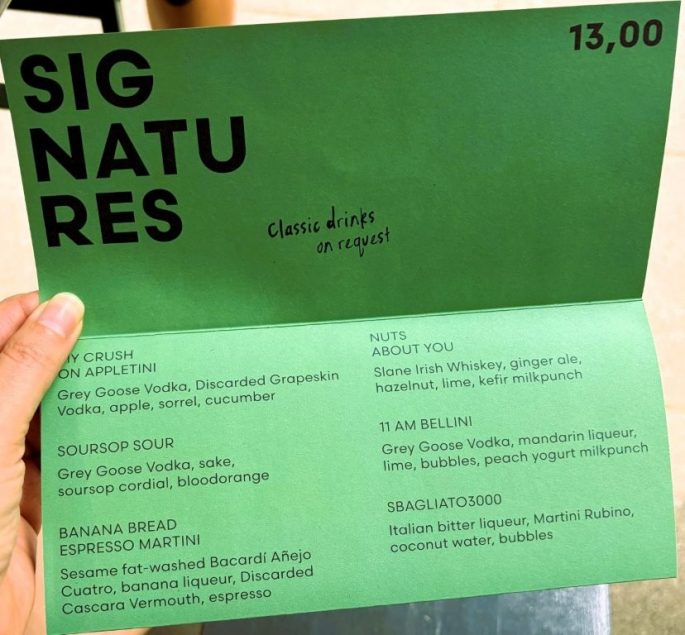
I went in a more aperitivo direction with a Sbagliato — bitter, sparkling and exactly right for the hour. One of those drinks that somehow makes an afternoon feel slightly more civilised. And then I spotted the Banana Bread Espresso Martini. There are combinations I can politely ignore. Coffee and banana are not among them. Sesame-fat-washed Bacardí Añejo Cuatro, banana liqueur, Discarded Cascara Vermouth and espresso sound dangerously close to dessert, but the drink has more depth than sweetness. Sesame brings a savoury, nutty note, banana the familiar comfort, while cascara and espresso pull everything firmly back towards coffee. Banana bread in a glass — but thankfully not liquid cake.
And perhaps that says quite a lot about Karo Karo. Familiar things are allowed to have a little fun here. Coffee doesn’t have to remain coffee, an afternoon doesn’t have to remain an afternoon, and a place doesn’t need to decide whether it wants to be a café, wine bar or cocktail bar.
What I remember most isn’t one particular ingredient. It’s sitting there with my neighbour, comparing our drinks and talking about flavour. The team was warm and attentive, and there was never any feeling that we should hurry. My Hamburg journey had taken me through bars built around culinary techniques, Equal Drinking, world maps and serious cocktail craft. Karo Karo reminded me of something simpler.
Sometimes drinking well doesn’t need to be an event. Sometimes it’s an afternoon with someone you know, a good conversation, one person drinking something gingery and the other deciding that banana bread apparently belongs in an Espresso Martini.
A little side trip for fellow Genussjäger: My neighbour Judith has her own delicious corner of the internet. On Naschkatze, she follows a slightly different trail than I do — through good coffee, cafés, recipes, food discoveries and culinary travels near and far. And yes, occasionally our worlds meet over a bar counter, as they did here in Hamburg. So if Barstalker takes care of your cocktail cravings and you are still hungry afterwards, have a look at Naschkatze. You might want to bring an appetite. Visit Naschkatze – Küchenglück & kulinarische Streifzüge
Drilling — Three Crafts Under One Roof
From aperitivo in the Karoviertel to cocktails and distilling in a former marzipan factory. Our little Hamburg Genussjäger tour wasn’t finished after Karo Karo. This time we left the Karoviertel behind and headed towards Bahrenfeld — and to a place that couldn’t have felt more different.

Read the full story →
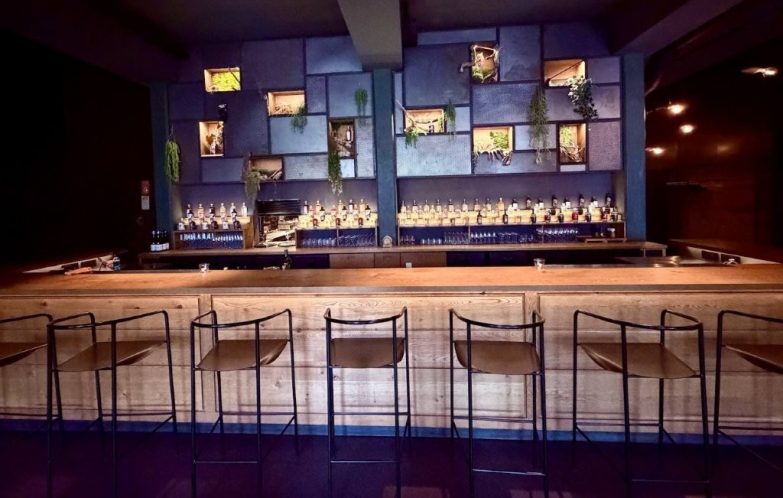
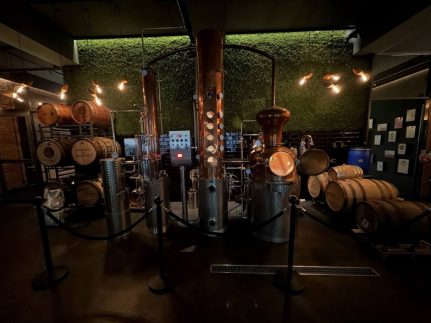
Drilling opened in August 2018 inside the historic boiler house of Hamburg’s former marzipan factory. Red brick and industrial details provide the backdrop for a concept built around three crafts under one roof: café, bar and distillery. Hence the name. All good things come in threes.
Behind the project is Thorsten Frerichs, also known from Hamburg’s clockers Bar. When Drilling moved into the old industrial building, not much remained beyond those beautiful red-brick walls. Instead of hiding that history, the new space embraced it, adding a distinctly Nordic-Scandinavian touch and turning a former place of production into one dedicated to a very different kind of craft. And that craft is what makes Drilling particularly interesting. The in-house distillery sits visibly behind glass, so what normally happens somewhere far away from the bar becomes part of the room. Gin, whisky, rum, fruit spirits and liqueurs are produced here, including JELLI, Hamburg’s first rum, and the wonderfully local Fränzchen — a Franzbrötchen liqueur actually made using real Franzbrötchen. Very Hamburg indeed.
I liked that transparency. We spend so much time sitting at bars discussing where spirits come from and how they are made; here, the journey can begin only a few metres away from your glass. The bartender isn’t necessarily starting with somebody else’s finished product. The story can begin with the spirit itself.
And yes, there was another counter. Apparently Hamburg really had decided to make bar furniture part of my journey. Drilling’s long counter is made from a single piece of oak, bringing warmth into all that brick, steel and industrial architecture. But look a little closer and you realise it isn’t only beautiful. Hidden drawers and clever little functionalities have been built into it to make life easier for the bartenders working behind it. I always like details like that — design that isn’t simply there to be admired, but actually understands the people who use it every night.
Naturally, that’s where I wanted to sit. And once you start looking around, there are more of those details to discover: the beautiful lamps, the seating areas, the combination of natural materials and industrial elements. Despite the history and scale of the old building, the room feels surprisingly warm, with a distinct Scandinavian touch rather than the rough industrial atmosphere you might expect from a former factory.

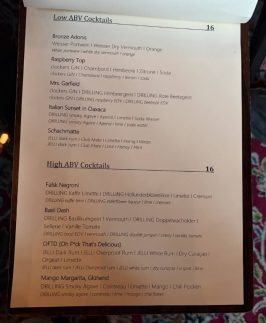
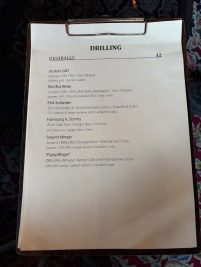
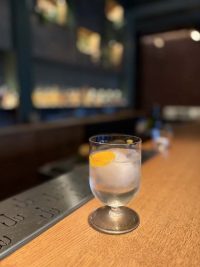
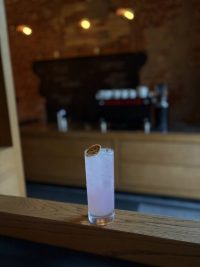
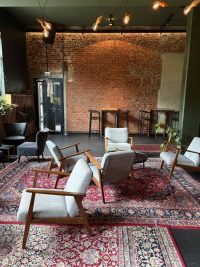
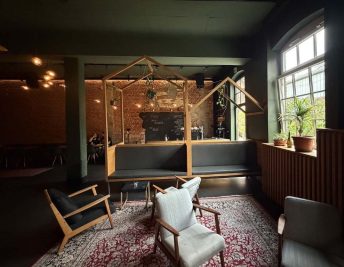
What I particularly enjoyed about Drilling was how everything seemed connected to the craft of making — the spirit, the cocktail, the counter, even the building itself. A place once built for production is still producing things; only what comes out at the other end has changed considerably. And once again, I wasn’t exploring alone. Two Genussjäger from the same small corner of southern Germany, several hundred kilometres from home, discovering another very different side of Hamburg together.
Good to know: The original Drilling concept combines café, bar and distillery, although the café and lunch are currently closed. The bar opens from 5 pm, and if simply looking through the glass isn’t enough, Drilling also offers guided gin, rum and whisky tastings that take you deeper into the production and the spirits themselves. More about the distillery, tastings and current opening hours at Drilling.
The Rabbithole — Classics, With a Way Out
Serious cocktail craft without taking itself too seriously — and another stop on my way through St. Pauli. My next stop took me back towards St. Pauli and down another little path on my increasingly long Hamburg bar map: The Rabbithole.
Read the full story →
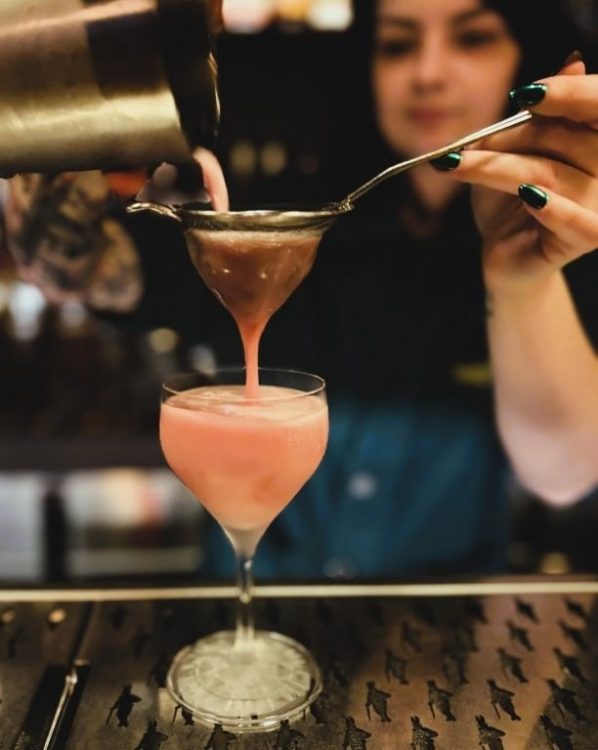
Opened in 2016 on Kleine Freiheit, The Rabbithole has been around considerably longer than many of the younger bars I had visited on this trip. In fact, I had already been here in its very beginnings and was curious to see what had happened since. I had heard plenty of good things over the years — but I certainly hadn’t expected another familiar face behind the bar.
There was Rebekka Salzmann, whom I know from Basel and had later visited at Goldfisch in Berlin. And now, quite unexpectedly, Hamburg. Apparently one recurring theme of this trip was walking into bars to discover something new and finding people I already knew instead.
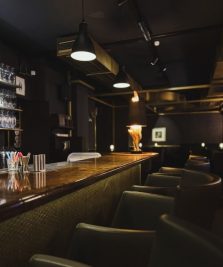
The room is much larger than you might expect from outside, with dark wooden floors, earthy tones, warm lighting and deep green upholstered seating. Further inside are leather sofas and little corners to disappear into, while the occasional rabbit quietly reminds you where you’ve landed. Thankfully, I didn’t have to disappear too far. I found my preferred territory immediately: the bar counter to the left as you enter.
The philosophy behind the drinks is refreshingly straightforward: understand the classics first, then decide where you want to take them. Contemporary devices and techniques have their place, but I particularly like one principle behind the drinks: as many ingredients as necessary, as few as possible. Technique should make a cocktail better, not simply make the menu description longer.
And then, of course, I started drinking. The beautifully illustrated menu offers plenty to explore, including The Flight Club, where three miniature Negroni variations become a little tasting journey. Tiny Negronis presented as a flight? Dangerous circumstances.
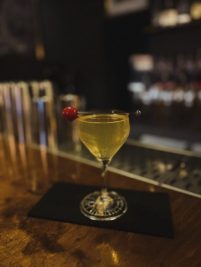
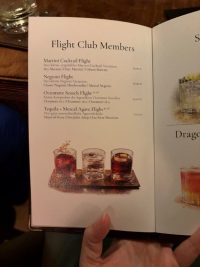
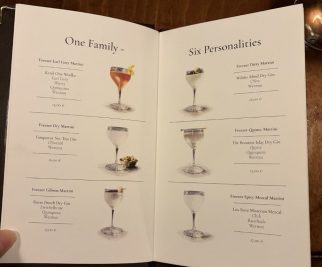
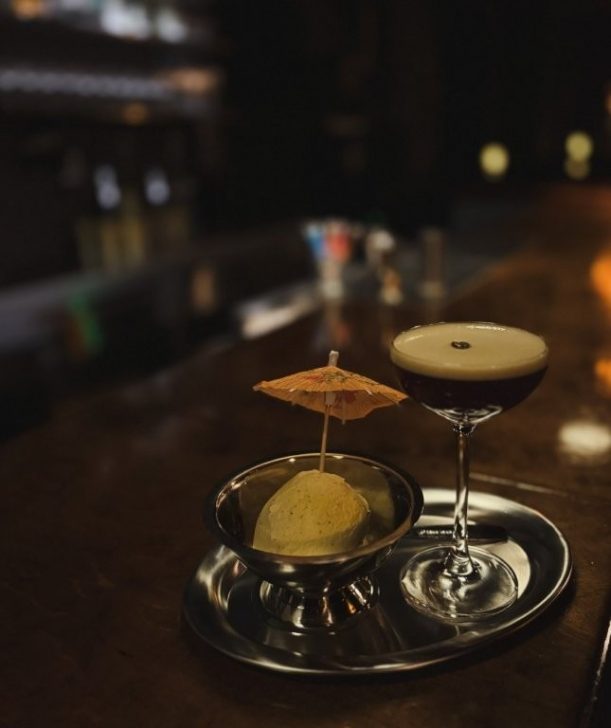
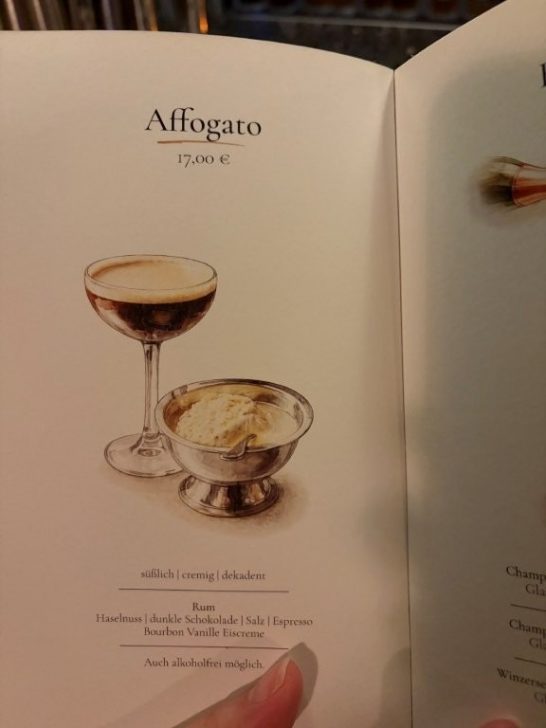
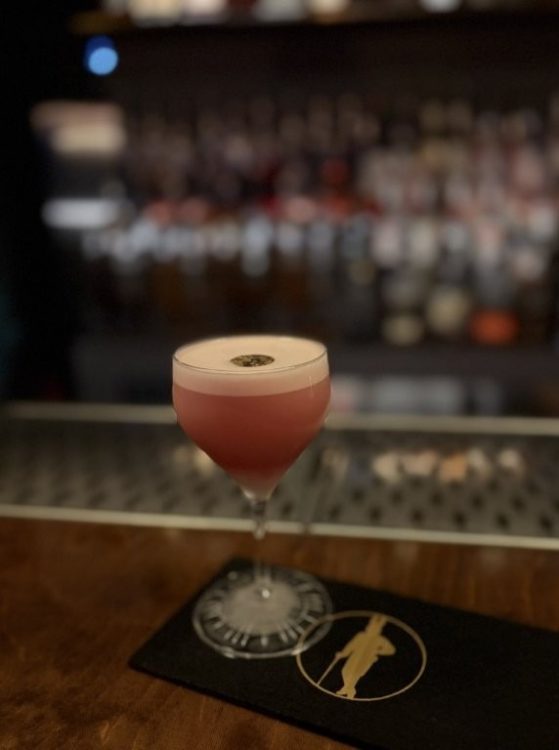
But something else caught my eye first: No Bunny Knows — smoky, herbal and tart, combining Los Siete Misterios Mezcal with blueberry and verjus. Just three main ingredients and a rather good demonstration of the bar’s philosophy. Next came La Tomato with pisco, tomato, cumin, port wine, chilli and lemon. Frankly, port and cumin were enough to make me curious. Savoury, fresh and spicy, it was one of those combinations that makes you pause after the first sip and figure out what exactly is happening in the glass. And because I am a big fan of Affogato, there was really only one possible ending. The Affogato arrived almost like a little Kännchen Kaffee on a terrace: rum, hazelnut, dark chocolate, salt and espresso with Bourbon vanilla ice cream. Coffee, dessert and cocktail in one. There are worse ways to close an evening. A nice detail is that several of the drinks are also available alcohol-free, following the same ideas rather than feeling like an afterthought.
What I like about The Rabbithole is that the classic cocktail is simply the starting point. An ingredient, technique or unexpected flavour then quietly takes it somewhere else. The same ease carries into the hospitality. Serious cocktails don’t require serious faces.
The Chug Club — Small Glasses, Big Agave Love
Tequila, mezcal and the dangerous logic that smaller cocktails simply mean you can try more of them. There are bars I visit because I’m curious about the concept. And then there are bars where everybody who knows me probably wonders why it took me so long to return. The Chug Club belongs firmly in the second category. Tequila. Mezcal. Agave. Enough said.
Read the full story →
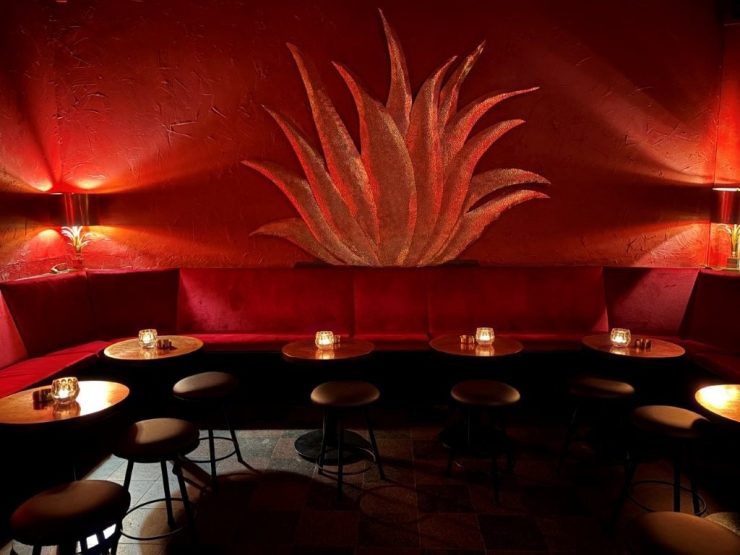
My first visit was almost a decade ago, not long after Betty Kupsa opened The Chug Club on St. Pauli in 2015. Back then, I was in Hamburg for a business training and naturally used my three evenings to work through a rather ambitious bar list. The Chug Club was high on it. I remember arriving early to secure my preferred territory at the counter, the colourful windows glowing from the corner and, once inside, dark wood, red walls and a golden menu full of possibilities. And then there were the Chugs.
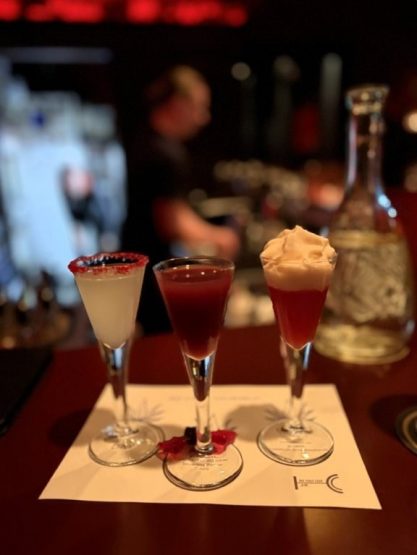
The idea was wonderfully simple: mini-cocktails that allow you to explore several flavours instead of committing to a procession of full-sized drinks. The bar still describes them rather perfectly today: Chugs are like tacos — small and delicious. For an agave lover, I consider that dangerous information.
Returning all these years later, the feeling was surprisingly familiar. The bar team welcomed me warmly, the room still had that unmistakable Chug Club character, and agave was still very much at the heart of everything. In a bar world where concepts and trends can change rather quickly, there was something reassuring about that.
The format has evolved a little. On my first visit, I worked my way through a five-Chug menu. Today the Chug Flight consists of three regularly changing surprise Chugs chosen by the bar team — still enough to explore, but perhaps slightly kinder to anyone planning another stop afterwards. Naturally, that was where I started. The first little glass was Bartender’s Choice, followed by Batgirl with liquorice-infused silver tequila, sour cherry syrup and citrus. Then came Dog Days: silver tequila, Fino Sherry, raspberry syrup, lime and a grapefruit-pineapple foam. Three small drinks, three very different directions — and exactly why the Chug idea still makes so much sense to me.
It turns drinking into tasting. You can move between sweet and savoury, familiar and slightly strange, tequila and mezcal, comparing one small glass with the next without turning the evening into a formal agave masterclass. And there is plenty more temptation on the menu. Long-standing favourites include creations such as Death by Erdnuss, combining reposado tequila with peanut butter, dark chocolate liqueur, vanilla and cream; Sesamstraße, with sesame-oil-fat-washed mezcal, Szechuan pepper, tomato essence, lemon and a sesame-salt rim; and Verditarita, where mezcal meets green chilli liqueur, pineapple, coriander, mint and lime. The names alone tell you that The Chug Club has never believed agave needs to be treated with excessive solemnity.
Because agave can become serious very quickly. Regions, species, production methods, terroir, fermentation, stills — there is an entire world behind tequila and mezcal, and one I happily disappear into. But you don’t need to know any of that to enjoy this bar. You can simply sit down and start tasting.
 One Chug. Then another. Perhaps one more for research purposes. Betty’s dedication to agave certainly hasn’t diminished over the past decade. In June 2026 she published her first book, TEQUILA – Die Seele Mexikos, devoted to the spirit, Mexico and the world of agave that has driven The Chug Club from the beginning. It feels like a rather fitting milestone for a bar that chose its niche in 2015 and never needed to chase another one. And after three Chugs? I went back to where so many agave stories eventually lead. A Margarita. Nothing deconstructed, reinvented or squeezed into a tiny glass this time. Just a solid Margarita to finish the night. Sometimes an old favourite is exactly what you need.
Almost ten years separated my two visits, yet sitting there again didn’t feel like rediscovering a forgotten bar. It felt more like checking in with an old acquaintance and finding that the reason you liked them in the first place was still very much there. The Chug Club didn’t discover agave because agave became fashionable. Agave is its reason for being. And perhaps that’s why the concept still feels so convincing after more than a decade. A bar stool. A few small glasses. A final Margarita.
Nick & Nora — A Familiar Face on the Shelf
Sometimes you walk into a bar and discover a new drink. Sometimes you turn a corner and unexpectedly find a little piece of your own story. My Hamburg journey eventually took me away from St. Pauli and across to Winterhude, where Nick & Nora sits rather beautifully on a corner of Mühlenkamp.
Read the full story →
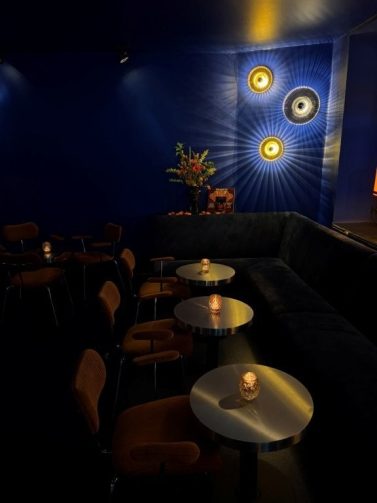
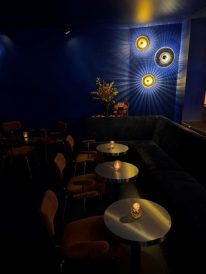
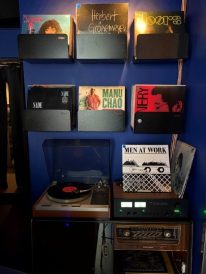
Even before stepping inside, there is something inviting about the place, and once through the door, it becomes one of those rooms where you immediately start looking around. Dark blue, warm wood, flowers, beautiful lamps and little details reveal themselves slowly rather than all at once. A record player and shelves of vinyl add to the feeling that somebody actually thought about how this room should feel, not simply how it should photograph.
Music is more than background noise here. Nick & Nora is the bar of Jules Koch and Timo Daniel, who came to Hamburg from Berlin and created their own place here in 2024. Their vinyl collection has become part of the personality of the bar, while the drinks follow a similarly elegant but relaxed direction: classics sit comfortably beside their own creations without the room ever feeling like it is trying too hard.
The name itself carries a little cocktail history. Nick and Nora Charles were the glamorous, cocktail-loving couple at the centre of the 1934 film The Thin Man and later lent their names to the elegant little Nick & Nora glass that has become such a familiar sight in modern cocktail bars. It all fits rather nicely with the atmosphere of the place.
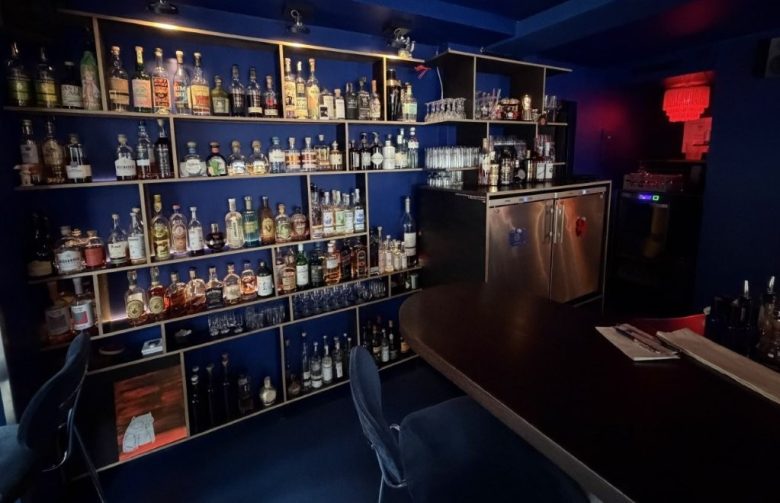
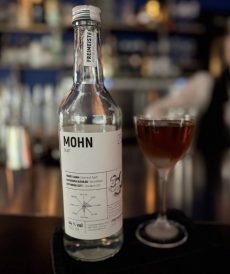
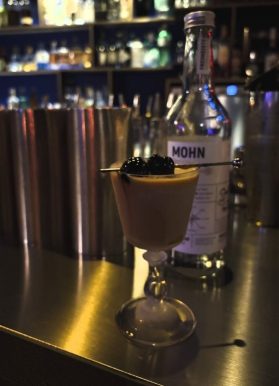
But my evening became much more personal when I walked around the corner of the bar and started browsing the beautiful spirits shelf — something I am apparently incapable of not doing in a bar. A few familiar labels immediately caught my eye: Freimeisterkollektiv. Not just one bottle, but quite a few. That already made me smile. I have a very personal connection to Freimeisterkollektiv, so finding their spirits behind a bar always feels a little like spotting familiar faces in an unfamiliar room. Then I noticed one particular bottle: Mohngeist — Poppy Seed Eau de Vie. I haven’t encountered it behind many bars yet, so seeing it sitting there among all those bottles caught me completely by surprise. Usually when I visit a bar, I don’t introduce myself or explain what I do. I like arriving simply as a guest, finding my seat at the counter and seeing where the evening takes me. This time I couldn’t help myself: “Oh my goodness — you have the poppy seed Eau de Vie?” Suddenly I had to explain why I was quite so excited about a bottle on their shelf, because this particular one carries a little piece of me with it. Mohngeist is a very personal project I created together with Freimeisterkollektiv, inspired by memories, family and my own connection to poppy seed. [More about the story behind Mohngeist here.]
There was something wonderfully strange about that moment. Throughout this Hamburg trip, I had kept running into people from my bar past — familiar bartenders appearing behind new counters and old connections resurfacing in different places. At Nick & Nora, I found another familiar face, only this time, rather unexpectedly, it was mine on the bottle. And Jules did exactly what you hope a bartender will do in such a situation: She put it into a glass. She created a drink for me with the Mohngeist, dry, slightly strong and beautifully restrained. There was no attempt to make the poppy seed sweet or overly obvious; instead, the spirit was given enough room to show itself. A rather fitting start to the evening and, admittedly, a slightly surreal one for me.
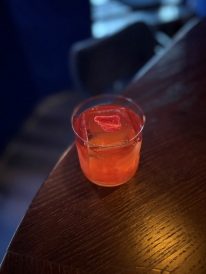
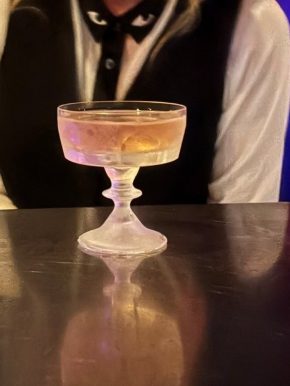
After that little reunion, I turned to the menu and started with Cherish, combining Johnnie Walker Black Ruby Scotch with strawberry, verjus and chilli. Berry-driven, crisp and lightly spicy, it had enough freshness to keep the fruit in check. Scotch and strawberry might sound like an unlikely couple at first, but that was exactly what caught my attention. Next came Electric Ladyland with mezcal, red vermouth, blackcurrant and bitters. Smoky, red-fruited and a little funky, it took the evening in a darker and moodier direction, with the mezcal and blackcurrant giving the drink plenty of character. And then there may have been a few other delights along the way. Some evenings are better experienced than completely documented.
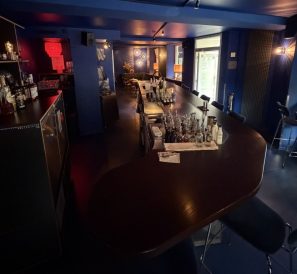
Beyond my little bottle reunion, what stayed with me about Nick & Nora was how coherent everything felt. The flowers and beautiful lamps, the warm lighting, the vinyl turning somewhere in the room, the carefully stocked back bar and that elegant corner setting all seem to belong to the same story. Nothing needs to shout for attention; you simply settle in, start looking around and gradually discover the details.
I came to Nick & Nora looking for another good bar on my Hamburg journey and found exactly that. I just hadn’t expected that somewhere between the records, cocktails and bottles on the back bar, I would also find a little piece of my own story sitting on the shelf.
NOU 7 — High-Tech Without the Show
In the same Winterhude neighbourhood as Nick & Nora, Asian flavours meet classic cocktails — with considerably more technique behind them than first meets the eye. Another stop on my Hamburg map took me to NOU 7 on Gertigstraße in Winterhude, just a few streets away from Nick & Nora. Same neighbourhood, completely different personality.
Read the full story →
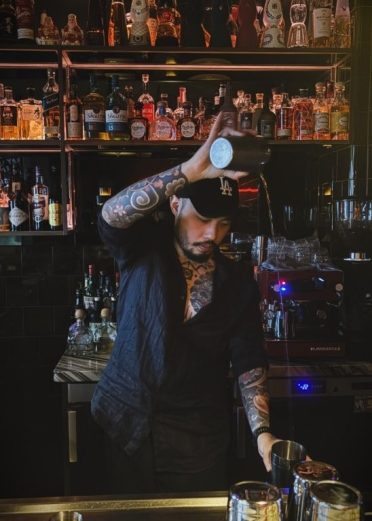
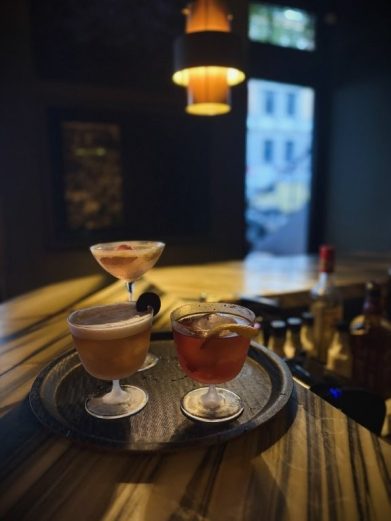
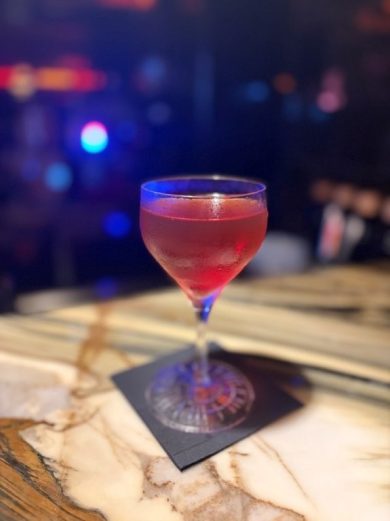
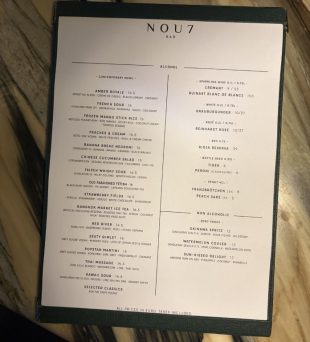
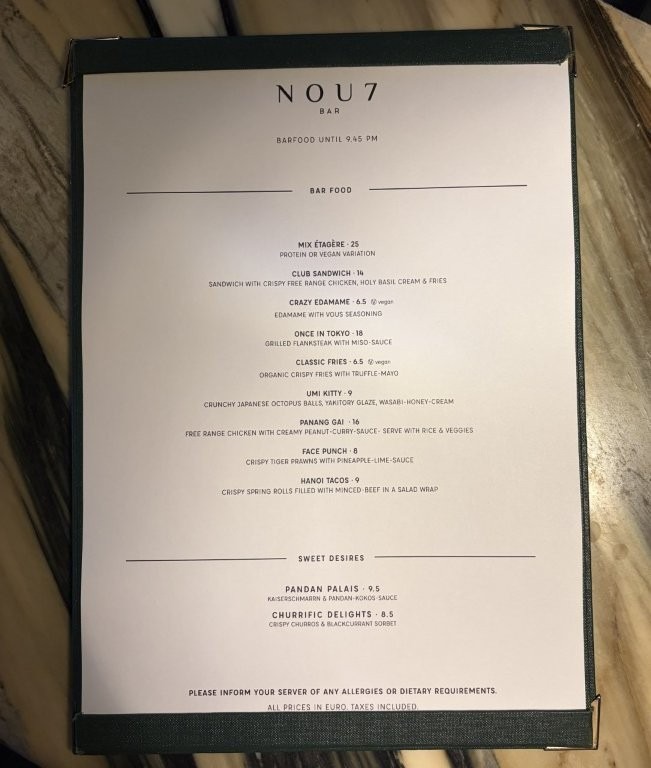
At first glance, NOU 7 feels refreshingly uncomplicated. More neighbourhood bar than cocktail laboratory, intimate and relaxed, without much fuss around what is happening behind the counter. But appearances can be wonderfully deceptive. The bar is connected to the Vietnamese restaurant Vous next door, and that relationship gives NOU 7 access to something many small neighbourhood bars can only dream of: a proper kitchen environment and plenty of contemporary equipment to play with. There is serious technique involved in preparing the drinks, but what I liked is that none of it becomes the point of the evening. You don’t sit there listening to a lecture about equipment. You simply taste the result.
The idea behind the cocktails is actually rather easy to understand: start with a classic, then look towards Asia. Sometimes one familiar ingredient is exchanged for an Asian counterpart, subtly shifting the drink in another direction.
In other creations, an Asian ingredient steps forward and becomes the star. The structure of the classic remains recognisable underneath, but the flavours take it somewhere else. With the bar manager’s (Duc Hai Vu) Vietnamese background and the connection to the restaurant next door, that influence feels natural rather than something added simply to make a cocktail sound exotic.
What stayed with me even more, though, was the hospitality. Hai welcomed me incredibly warmly, showed me around and took the time to explain what happens behind the scenes. Once the team realised that I might be slightly more cocktail-obsessed than the average guest, things became even more interesting. There were extra drinks to taste, details to discover and that lovely kind of conversation that happens when the people behind the bar realise the person sitting opposite genuinely wants to know. Dangerous territory for a Barstalker.
From the menu, I started with the Taipeh Whisky Sour, combining Singleton 15 with milky oolong, winter melon and lemon. It is a good example of the NOU 7 idea: the familiar Whisky Sour provides the framework, while tea and winter melon gently shift its flavour profile towards Asia without losing the character of the classic underneath. But then things moved off-menu. Hai began making drinks of his own for me, and that was where the evening became particularly enjoyable. Rather than simply working my way through a list, drinks appeared that matched the food and the conversation, turning everything into a much more personal experience. And the food deserves its own mention. Coming from the attached restaurant, it isn’t the usual bar snack added because people eventually need something to eat. The same playful meeting of cultures continues on the plate. Spring roll tacos, for example, bring Asian and Mexican street-food ideas together — fun, delicious and exactly the sort of thing you want to keep picking at between sips. With the drinks made to accompany them, bar and kitchen started to feel less like neighbours and more like two parts of the same experience.

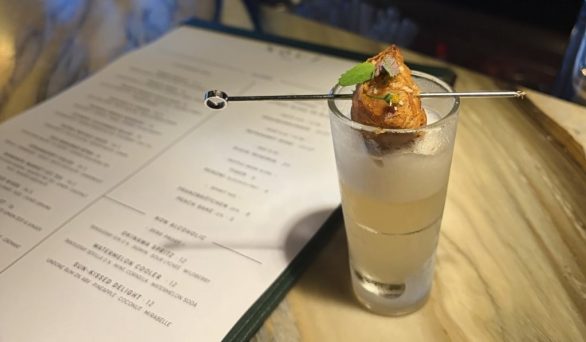
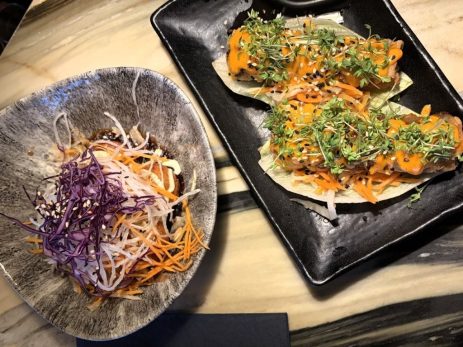
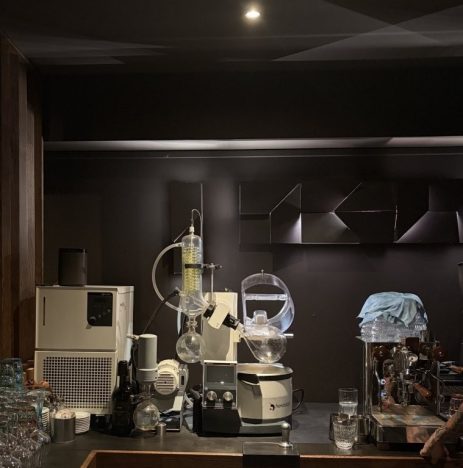
Perhaps that is what surprised me most about NOU 7. The technical standard is extremely high, but the bar doesn’t build its identity around telling you how clever it is. All the equipment and preparation remain backstage where they belong. What arrives in front of you is simply a very good drink with a clear idea behind it — and, in my case, some very good food alongside it. That combination is harder to achieve than it sounds. Technique can easily become theatre in modern cocktail bars. At NOU 7, it feels more like a tool: use whatever is necessary to get the flavour you want, then get out of the way and let the guest enjoy it.
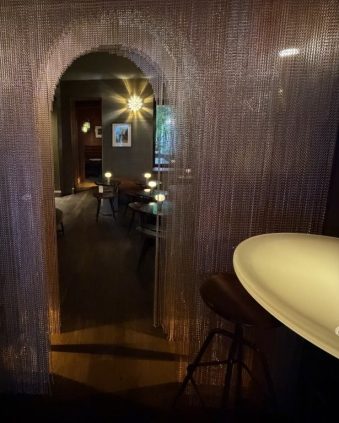
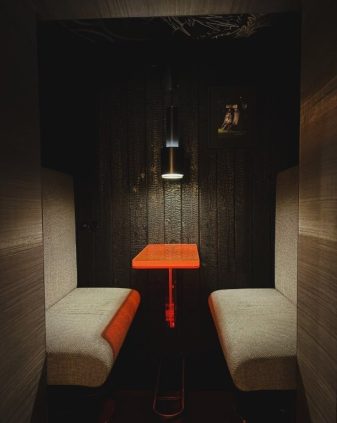
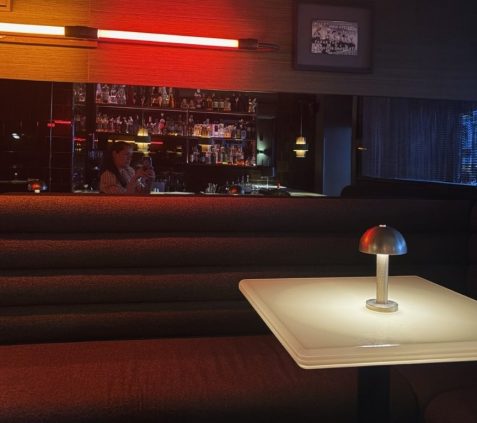
Neighbourhood-bar ease, Asian flavours, serious technique and a kitchen right next door – NOU 7 doesn’t make a big fuss about any of it. Find Nou 7 on Instagram.
SLOMO HiFi Bar & Café — Please Don’t Shake the Music
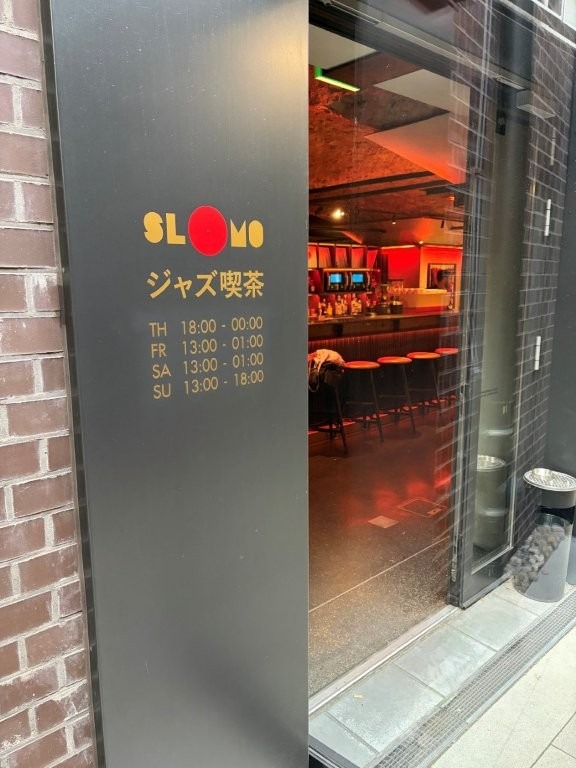
My last Hamburg bar adventure took me underground — to a place where vinyl comes first and even the cocktail shaker has been asked to keep quiet. Sometimes the best recommendations come from people who simply say: You need to go there. A colleague had mentioned SLOMO to me, one of Hamburg’s newest bars, and this time the recommendation really hit the nail on the head.
Read the full story →
For my final bar adventure in Hamburg, I headed towards HafenCity and Shanghaiallee 7. SLOMO only opened in May 2026 and is hidden in the basement of the PROTOTYP automobile museum, inside a listed former factory building. From the busy modern architecture of HafenCity, you suddenly descend into a completely different world — darker, warmer and deliberately slower.
SLOMO is part café, part cocktail bar and, above all, a listening bar. The inspiration comes from Japan’s jazz kissas: places created not simply to have coffee or a drink while music happens somewhere in the background, but to actually listen. Vinyl, carefully selected music and a serious sound system become as important to the experience as whatever is in your glass.
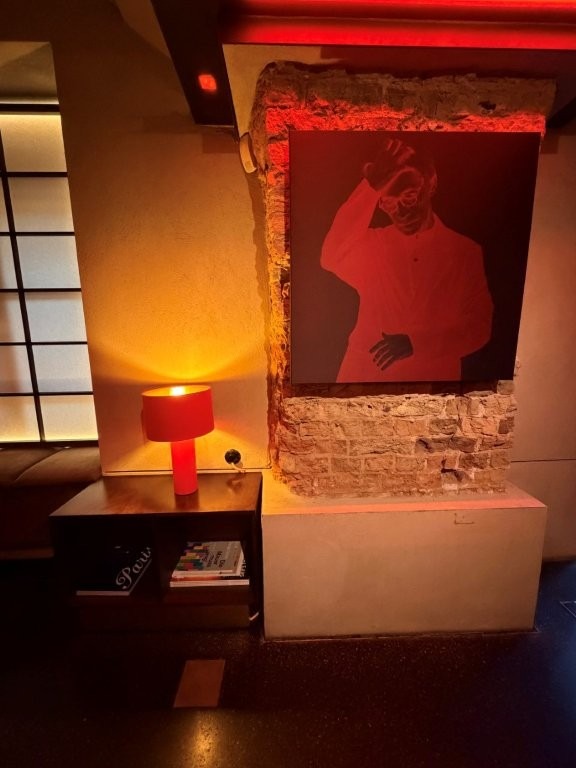
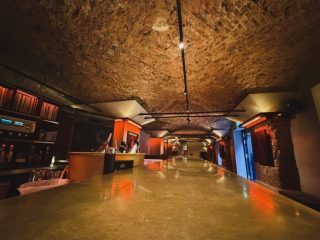
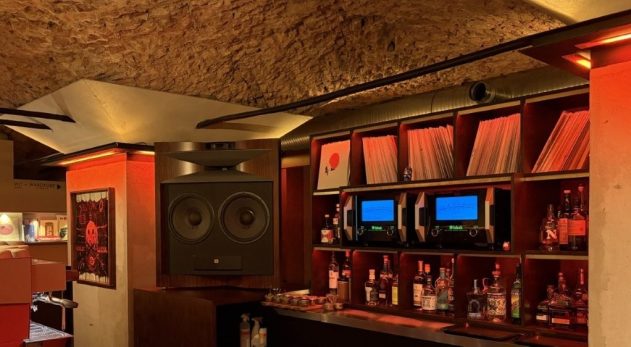
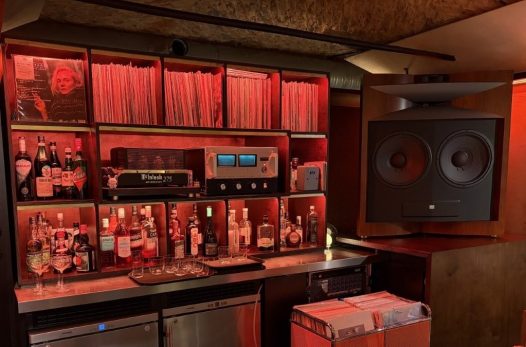
During the day, SLOMO serves coffee and matcha; later, the focus shifts towards cocktails and curated music sessions. That Japanese connection immediately resonated with me. During my travels through Japan, I had already encountered places where music, coffee, drinks and a carefully designed room seem to belong together naturally. There is something wonderfully old-fashioned about being asked to give music your attention rather than allowing it to disappear underneath conversation and notifications. And SLOMO has built the room around exactly that idea. The long, low basement space is softly lit, with shelves filled with vinyl and the sound system given the importance it deserves. It feels warm and intimate rather than technically intimidating. This isn’t a bar that happens to own a good stereo. The sound is part of the architecture.

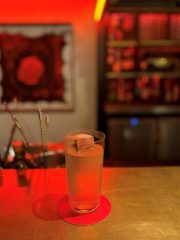
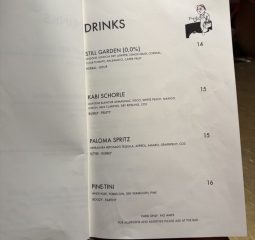
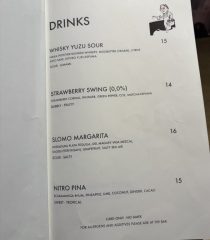
The drinks at SLOMO are pre-batched. Shaken cocktails are deliberately absent from the regular menu. Not because the team couldn’t make them, but because shaking would interrupt what the bar has been designed around: the music. We spend so much time in cocktail bars talking about how far a bar will go for a drink. Here, somebody had asked the opposite question: How far should a drink step back for the room?
Apparently, if you stay late enough and ask very nicely, there might occasionally be a vigorously shaken Daiquiri after midnight. At least that’s what the bartender confessed when I asked. But exceptions aside, the principle remains wonderfully uncompromising: the cocktail shouldn’t disturb the record. And that doesn’t mean the drinks are an afterthought. Quite the opposite. The menu leans into Japanese influences, with signatures built around ingredients such as matcha and yuzu, but the preparation happens before the drink reaches you. What looks effortless at the bar is the result of work done quietly behind the scenes.
What I particularly liked was that SLOMO doesn’t treat its listening-bar identity as decoration. The music programming is part of the concept, with vinyl sessions, DJ sets and dedicated listening events rather than simply somebody pressing play on a carefully branded Spotify list. There is something rather refreshing about a new bar opening in 2026 and asking people to slow down. And perhaps SLOMO was exactly the right place to finish my Hamburg journey. Over the course of these bar adventures, I had found extraordinary counters and tiny Chugs, travelled through flavours, watched spirits being distilled, reunited with familiar bartenders and even unexpectedly discovered the Mohngeist sitting on a back bar. Hamburg had given me plenty to look at, taste and talk about.
My last stop simply asked me to listen. Not a bad way to end a Barstalker journey. Find SLOMO on Instagram.
Fazit — Hamburg Doesn’t Need to Shout
After all these bars, all those counters and considerably more cocktails than originally planned, one thing stayed with me: the standard in Hamburg is remarkably high. Not because every bar is trying to do the same thing. Quite the opposite. At Bā Nomu, memories of food and Asian flavours become cocktails. Collab questions why alcohol should determine how seriously we take a drink. The Local proves that ambitious cocktails can live comfortably alongside beer and neighbourhood-bar hospitality, while Liquid Garden sends you travelling through flavours from around the world. Karo Karo blurs the line between coffee, aperitivo and night, and at Drilling, the story begins with the spirit itself, distilled only metres from where you drink it.
Then there were the places that reminded me how much history already exists within Hamburg’s modern bar scene. The Rabbithole still builds from the classics while happily playing with contemporary ideas, and returning to The Chug Club almost a decade after my first visit showed me what happens when a bar follows its own obsession rather than the latest one. Agave was its reason for being long before agave became everybody’s favourite new playground. In Winterhude, two bars only a few streets apart demonstrated just how broad the scene has become. Nick & Nora gave me vinyl and elegant cocktails and the rather surreal experience of discovering my own Mohngeist on the back bar. NOU 7 went in another direction entirely: Asian flavours, serious technique, food from the restaurant next door and an extremely high standard without making a fuss. And finally, SLOMO asked both drinks and guests to quiet down and listen — a listening bar where even the cocktail shaker steps aside for the music.
Looking back, perhaps the most interesting thing is that I can’t really define a typical Hamburg cocktail bar anymore. And that’s a compliment. The pioneers of Hamburg’s modern cocktail culture created an important foundation. But a city cannot live forever on the reputation of its institutions. Bar culture moves on. New bartenders arrive, new ideas develop and standards that once seemed exceptional become the starting point for the next generation. That is exactly what I found in Hamburg.
There was impressive technique everywhere, but rarely technique for its own sake. Fermentation, clarification, distillation, fat-washing, batching and all the other toys of the modern bar were there when they made a drink better, but the strongest places didn’t feel the need to explain how clever they were.
More often than not, what arrived in front of me was simply a very good drink. And behind it, very good hospitality.Perhaps that was my biggest discovery. Hamburg’s cocktail quality is not concentrated in one famous bar, one neighbourhood or one generation anymore. I found it in St. Pauli and Winterhude, in the Karoviertel and Bahrenfeld, in HafenCity and beyond; in established institutions and places that had barely opened their doors.
And I haven’t even properly touched the city’s restaurant bars and hotel bars yet. There are more neighbourhoods, more counters and certainly more bartenders whose stories deserve to be told.
So this isn’t a definitive guide to Hamburg — nor was it ever supposed to be. It is simply the trail I followed this time.
Hamburg once needed a few pioneering bars to put it on the cocktail map. Today, I don’t think it needs a single flagship to prove anything. The scene itself has become the reason to come. And for a Barstalker, that means only one thing: I’ll have to come back.